New Zealand's food story only keeps its value if it can be proven, and proof depends on a connection that works on the farm. That was the thread running through Agritech Unleashed Otago, and it is why we were glad to back the day.
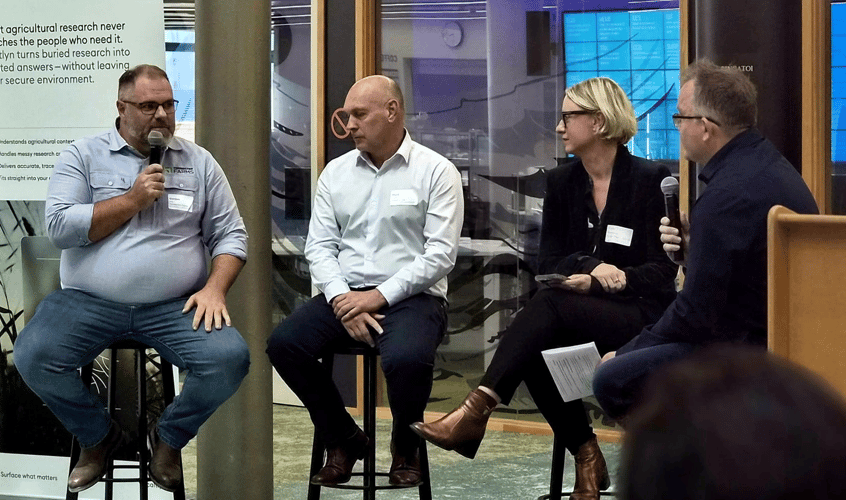
Connected Farms sponsored the event in Dunedin on 12 November, and our Head of Sales, Gordon King, joined the closing panel, "Our journey to a truly connected ecosystem". He sat alongside Kate Beddoe of Silver Fern Farms and Prism Earth and Matt Lythe, Managing Director of Prism Earth, with Brendan O'Connell, CEO of AgriTech New Zealand, moderating. Here is what we took away.
Trust now has to be proven, not promised
The panel opened with a point that framed everything after it: customers overseas are asking for evidence. Buyers are reaching deeper into supply chains and want verifiable data on things like emissions, water and nature, not just a good story about where food comes from.
New Zealand starts from a strong position of trust, but the panel was clear that it cannot be taken for granted. In a more sceptical world, a premium has to be earned with proof. The same goes for farmers: if a farming system is worth a premium, the data has to be there to show it.
That is a measurement challenge, and measurement starts in the paddock. Sensors, satellites and on-farm systems can only produce proof if the data from them actually gets where it needs to go.
Farmers want outcomes, not more technology
Gordon's view from the farm side was that farmers are not turning technology down because they love their notebooks. They are turning it down when it is hard to set up, hard to keep running, or adds yet another app to the day.
The panel agreed that adoption fatigue is real, and that the technology that sticks is the technology that delivers a result a farmer can see. Another panellist added that when there is a clear premium or incentive attached, adoption moves quickly.
For us this is a useful test. If a farmer cannot say what they got out of it, it is not finished.
Connectivity is the foundation
Gordon's central point was about order of operations. Farming is moving from notebooks to sensors, automation and data, but the infrastructure underneath has not always kept pace. The data that matters, such as animal health or soil and pasture growth, should come from the paddock, and that depends on a connection that reaches it.
He described a crawl, walk, run journey. Connectivity is the crawl stage, and in his view it has not been finished before the industry jumps to the run stage of intelligence. The 3G network switch off last year was a reminder of how quickly farmers can lose connected equipment they already rely on.
Satellite options such as Amazon Leo are a big step forward for rural connectivity, and we are glad to be working with them. But satellite on its own does not solve every problem on the farm itself, and there is no point layering intelligence on top before the connectivity foundation is sorted.
This is how we think about it at Connected Farms: connectivity is the foundation, compute is the multiplier, and intelligence is the payoff.
Who carries the cost, and who gets the value?
The second half of the conversation turned to nature as an asset. Panellists argued that natural capital should be treated like any other productive asset: it takes time and investment to look after, so its value should be recognised and rewarded, whether through a market premium or through emerging nature markets.
Gordon raised the practical side. Farmers often carry the cost of the infrastructure that makes this data possible, so the question is whether the value coming back from that data reaches them too. It is a fair challenge for the whole sector, and one we will keep asking ourselves.
The room also pushed on whether this works for every kind of farm and whether farmers can intensify while still showing strong environmental credentials. The panel's answer was that both are possible, and that the data is what makes it provable.
The rest of the day
Alongside our panel, the day included a keynote from Jarred Mair of MPI on what will reshape farming and agritech by 2040, a panel on adoption moderated by Tom Woutersen of Halter, and workshops on data and adoption. Thank you to all the sponsors and presenters
Thank you, and what next
Thank you to the AgriTech New Zealand team for a well-run day and for the invitation to be part of the closing panel, and to Kate and Matt for a thoughtful conversation.
We are proud to be part of a journey that helps New Zealand's agriculture sector succeed through connected, trusted technology. If you would like to talk about getting your farm or your product connected, get in touch with our team.